Robert Frank: object-oriented photographer

Revised version of my Frank musings.

“The photographing of America” is a large order — read at all literally, the phrase would be an absurdity. What I have in mind, then, is observation and record of what one naturalized American finds to see in the United States that signifies the kind of civilization born here and spreading elsewhere […] I speak of the things that are there, anywhere and everywhere — easily found, not easily selected and interpreted. A small catalog comes to the mind’s eye: a town at night, a parking lot, a supermarket, a highway, the man who owns three cars and the man who owns none, the farmer and his children, a new house and a warped clapboard house, the dictation of taste, the dream of grandeur, advertising, neon lights, the faces of the leaders and the faces of the followers, gas tanks and postoffices and backyards…” Robert Frank’s original Guggenheim application{Greenough 2009@362}.

Robert Frank’s paper road movie The Americans{Frank 2008} is a picture of American objects and those objects are, by the necessity of his project, ontologically flat, democratic – present but distinct and withdrawn.

There are people yes, but also flags, jukeboxes, crosses, cigars, hats and cars – a Latour litany of human, non human and unhuman objects vibrant, doing things in the world. Those objects were material.  The flat ontology, the materiality was necessary because Frank’s project was a different sort of documentary. He was after “the Americans”, not just American people or some abstract “America”, but the Americans (human and unhuman) that as objects made up that mesh.

These objects were the presences he encountered on his journey and he made re-present in his book. These real objects had histories, material conditions of production and consumption. They had pasts but also presents and presence as the jukebox watched over the crawling baby, as the cars watched over the kids making out. Most of the photographs Frank chose for The Americans included people but this was no humanist or correlationist story. Where Steichen’s The Family of Man{Steichen 1983} led with people, privileging the human over a material world of object with which he struggled or for which she cared, Frank’s people are actants in a complex mesh of objects. The working class lift operator and waitress or the society aristocrat or movie mogul are objects alongside a Santa Claus sign or a fur stole. These objects are not semiotic markers of an underlying class relation and more than the human is an archetype. They are all objects in the complex assemblage of 1950s America connected and connecting not at some external representational scale but in real world materiality of serving drinks, being ignored buy commuters or forging social and business networks. Frank is not external to this. He too is an actant. His shadow or gaze is woven into these object relations as it falls on windows or is returned suspiciously. There is no objective recorder or photo-journalistic position. There is only the position of object.

The Americans is a nested work. The objects in the coffee-bar or on the street are connected within other objects. The sousaphone-object, the flag-object and the ‘Adlai’-badge-object connect as object within the parade-object. There is no decisive object, no punctum driving the story or the meaning. These object connect again and again with Frank within his camera-object, with the book-object. These connection are not located in some external realm of signification or practice but within objects that are themselves actants reconnecting within other objects.

The image-objects are not somehow different to the objects in the images. They are not more or less than those objects. They are just different. The photographs (or the reproductions of the prints of the negatives…) are objects now positioned in new object-relations with the bookmark on my desk, my words on the screen, the print-out of my chapter, the code of my own images, the protocols enabling those images.

Frank approached the objects in Cafe – Beaufort, South Carolina as actual presences. The jukebox, baby, chair, light and mat were fully present but exceeded their relations, qualities and accidents. He could not see nor photograph the quantum dance at the subatomic level within the jukebox glass, the baby’s hair or the photons of light. He could not see nor photograph the rear of the jukebox. There was more to each object than the particular manifestation before his lens. The objects withdrew but it was in that withdrawal that Frank could work. It was the fact that those objects were all equal ontologically and photographically that enabled him to take this photograph and make it work with all the others in The Americans. Most importantly each object was actual. It was not defined by its relations to any other, a plasma or a potentiality. The jukebox. The DNA in the baby. The wooden chair leg were all real, material and vibrant regardless of any other object. But there were connections. They connected with each other in the heart of other objects. The real baby object connected with the sensual floor object (a dimension of the floor object) within another object – the cafe-baby object that Frank connected with as he pressed the button and as exists now as part of Cafe – Beaufort, South Carolina. The objects are not just compositional building blocks, they are ontological ones too. And Frank’s practice depend on them so he could create image-objects.
Tweets for the week :: 2011-11-20

Powered by Twitter Tools

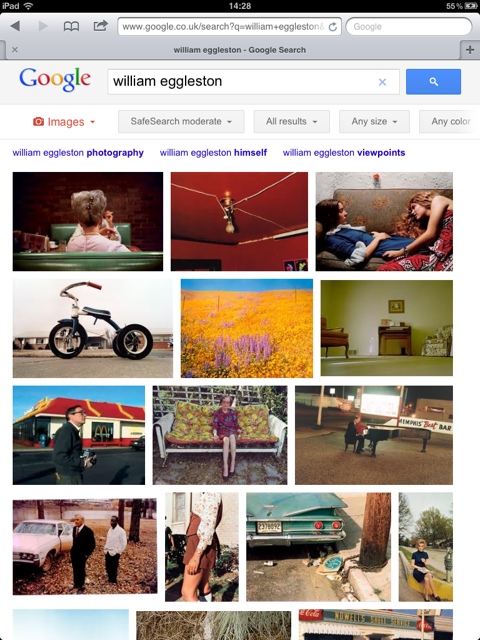
William Eggleston: object-oriented photographer

20111116-142830.jpg

“Bill at one time said to his great, highly-respected friend: ‘Well what am I gonna photograph? Everything around here is so ugly.’ And our friend said: ‘photograph the ugly stuff'” Rosa Eggleston (Wife) in{Holzemer 2008}.
“I’ve seen him stare for hours at a china set. And not a particularly valuable china set” Andra Eggleston (daughter) in{Holzemer 2008}.

New York Times critic Hilton Kramer and MoMA curator John Szarkowski famoulsy agreed that William Eggleston’s style was ‘perfect’. For the curator, Eggleson’s saturated colour was a ‘snapshot aesthetic’ taken to an extreme, perfectly attuned to a saturated imagespace and postmodern sensibility. To the critic, the images were indeed perfect: “perfectly banal, perhaps. Perfectly boring, certainly”.

The important point about their reading of the show in 1976 was that point of agreement: “perfectly banal”. Eggleston embraces the banal by working with an through objects. His modestly entitled “Guide”{Eggleston 2002} is no catalogue to the exhibition, monograph of an oeuvre or photobook. More like a child’s I Spy book or a throwaway pamphlet sold with an admission ticket, the Guide makes no pretence to be anything other than a tour of objects in Eggleston’s South.
An unfinished jigsaw in Tallahatchie County, Misssissippi; a creek in Summer, Mississippi, Cassidy Bayou in background; a shower or a child’s tricycle in Memphis – objects on Eggleston’s tour. The bus stops, and on your left…

The objects’ banality is not a value judgement so much as an ontological statement. The Guide is not random. Eggleston selects the objects carefully, but without prejudice. The Guide is democratic but never fully comprehensive. The objects admitted, drawn to the attention of the scopic tourist share an ontological banality but presence. Real but really withdrawn; sensual but never fully accessible.

Eggleston famously refuses discourses of interpretation or to answer questions. When someone says: “You often photograph food. What does food say to you?” he replies: “Food does exist sort of like cars exist”{WallToWallMedia 2009}. His is the photography of “if your meet the Buddha on the road, kill him”. If he refuses or is unable to find the depth within his work, so are his objects. The green shower tiles and nozzles in Memphis may evoke Psycho or Auschwitz but they are not about Hitchcock, the gaze, evil. They are tiles… in a bathroom… in Memphis. The get wet. The flashlight reflects off them. As dye, ink or pixel traces in an image they may re-present but that is not their totality. They may connect with memory-objects, undergraduate Film Studies essay-objects or MoMA brand objects but those connections forged in the molten core of objects cannot exhaust the tiles or the image of the tiles. Eggleston’s grumpiness is an ontological statement – needless to say, were I to present that thesis to him, he would quite rightly dismiss it.

When one sees Eggleston work (admittedly in the presence of another scopic apparatus) {Holzemer 2008}, it is suffused with the everyday. Here there are no decisive moments snatched from the flow of time, no stalking and waiting nor even flanerie and chance encounters. Eggleston gets out of his car, stops, raises his camera before another object, clicks and walks quietly on. It is not just his age that means he moves and images slowly, elegantly, undramatically. When he says to the filmmaker: “Grab any masterpieces yet?” before bending slightly to imagine under a truck, it is another sly Eggleston dig. There are no masterpieces distinct from the banal. There are no decisive moments or perfect compositions to be captured or created. There is is just this… and this… and this.

His refusal to title or date his images is more than just a Zen refusal of labels – fingers pointing at the moon. It is a sensibility towards the ‘this’, a willingness towards objects, a positive statement about their withdrawal yet very real accessibility as sensual presences, understood in terms of objects not fields of relations or time.

When he rounds a corner and something catches his eye he does not dance around looking for the perfect position to take the image or shoot different frames or compositions. He raises his camera and… He says:

“I do have a personal discipline. I’ve only taken one picture of one thing. Not two. I would take more than one and get so confused later when I was trying to figure out which was the best frame, I said: ‘this is ridiculous, I’m just gonna take one that’s gonna be…”

Photographer Martin Parr says Eggleston’s vision is: “about photographing democratically and photographing nothing and making it interesting”. I would agree with the first part but argue with the second. Eggleston is not in the business of making nothing interesting. For him there is no ‘nothing’ only ‘something(s)’ and they are already interesting.

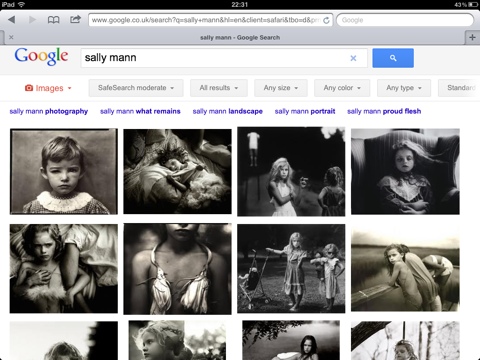
Sally Mann: Object-oriented photographer

20111113-223206.jpg

Part of the fuss around Sally Mann’s collection Immediate Family was that she had turned her children into objects. In the images of their childhood in rural Virginia, parts of their pre-pubescent bodies that should only have been visible (a matter of concern) to their parents had been objectified. The girl or boy, the ‘child’ maybe ‘childhood’ had become an object for Mann the artist. Further, Mann’s cumbersome view camera had become an object in their growing up, an interloper in the childhood where it had no right to be.

In her later work What Remains, Mann was again accused of objectification. As the omniscient artist-subject she had violated another taboo, turning decomposing corpses in an FBI scientific facility into ‘bodies’, objects of her art. Once again, she as subject turned her camera on objects.

But Mann is an object-oriented photographer in a real not a caricatured sense.

Her images are of objects connecting: the sacks next to Virginia in Virginia Asleep, 1988; The Yard Eggs, 1991; the adult earring and necklace around Jessie’s neck in Jessie at 5, 1987 – these are are as much the ‘child’ as the famous naked bodies. In Mann’s object-oriented photo-philosophy, they are players in the ‘childhood’ and the ‘family’ objects. Her’s is a democratic eye, but not an un-discerning one. Every object is carefully composed and connected.

But more than just a litany of objects on the groundglass, Mann is object-oriented in her sense of her own objectness. Her work with objects is not as a separate subject, standing outside the flux of material things in the world. Her’s is not a dispassionate eye secure in its subjecthood and correlationist relationship to ‘the world’, ‘the family’, ‘the South’. Sally Mann is an artist-object enfolded in the mesh of objects, connecting within the heart of new objects: “the Mann family”, “the Civil War”, “death”.

Mann’s object-oriented sensibility extends beyond her democratic eye. She is fully present in her images. Immediate Family is as much a picture of her as of her children. She is modelling just as they model. Her images of Civil War battlefields are less of landscapes out there, than of the interior landscape she argues Southerners carry with them. Mann knows that she is at the same ontological scale as her children, their childhood objects, her home and history.

Mann’s use of not just ancient cameras and lenses but also antique processes is also a part of her object-oriented sensibility. The glitches her technologies introduce, like the cliched inclusion of the photographer’s shadow, inscribed the technology-object across the image. The ‘failed’ coating of the wet collodion plate, the dust, the refracted light in the ancient lens, are themselves objects connecting with each other, with Mann, the thing being photographed, the gallery, the art market and… Mann is open to those objects. More, she embraces them and their connections.

Mann the photographer is co-present as an object in the mesh of her imaging in the shape of those glitches, faults, qualities. This is not some self-reflexive gambit simultaneously modernist in foregrounding the medium but also postmodern in playing with the death of the auteur-imager. Rather it is an object-oriented sensibility, a realisation and acknowledgement of the inevitability and power of object meshes within imaging.