Paper given at the Perceptions of Practice conference, Nottingham Trent University 11.07.11
When Robert Jackson, who you will hear from later, visited my home for the first time the other night, he remarked: “what a lot of stuff”. He meant it as a complement, an observation that mine was a family home not a show house, at least that’s how I took it. My wife may have read it differently as part of her Sisyphean task to counter my, and the children’s archiving strategies.
My home is full of stuff. Just looking across my desk as I write this: Books, of course, notebooks and index cards, pens, glasses case, a Direct Debit mandate, keys, coffee cup, wallet, ink bottle, memory stick, Oystercard and a small plastic elephant. Elsewhere in my office much of the stuff is photographic. Cameras: digital, analogue, pinhole. Prints: some framed, some in boxes, some pinned to fridges and noticeboards. Negatives: some in sleeves, some rolled in 36s. Slides: some mounted, some in strips. Digital files: in libraries, on hard drives or servers. I am not unusual in my saturation in stuff. Perhaps my love of materiality means more of my stuff is on my desk and not Facebook’s servers, but we live, work, image and imagine in a world of stuff, of objects.
This is the theme of my photography, my research and my talk.
As a photographer I am interested in what Jane Bennett calls vibrant material and Sherry Turkle refers to as evocative objects. As a form of documentary photography I look to focus on objects with histories, presences and a power that goes beyond semiotic representation. Most recently I have been working on two projects: The Thing of the Day and the Olympic Arcades.
The Thing of the Day is simply a series of iPhone pictures of… things. Objects I encounter. For Jane Bennett, things have a power, a vibrancy even a capacity for a form of agency – an ability to do things. Of course each has its own history of workers exploited in Far East sweatshops to make plastic toys for McDonalds, a carbon footprint as they are flown across the world or buried in landfill. Of course each signifies and resonates with memories. But these objects are not passive bearers of the traces of globalisation, or of signification. They are active players – actants in Bruno Latour’s terms. For Bennett they call to us, they effect us. Like microscopic particles effect our body chemistry so organic and inorganic objects, human and unhuman actants have ecological and physical effects
In a similar vein, Sherry Turkle’s account of ‘evocative objects’ is not a eulogy to semiotics resonance. It is an account of how objects enfold themselves into signification and meanings but also into practices. They have a depth that exceeds their power to ‘mean’.
The lego brick, petal or plastic cup signify, for me and for you. They carry the traces of their production and consumption. But their existence as objects exceeds these relations. As we shall see, they withdraw from all access yet encounter other objects (including us) in powerful ways.
The second project looks to and for objects around the Olympic Fence in London. Rather than looking to document 2012 or even the liminal spaces around the Fence, I looked for and photographed objects – litter, ancient mooring rings, the screw holding the security camera pylon. These were not meant to ‘mean’ anything, to symbolise or even objectively document. Rather they were meant to acknowledge the presence of material objects alongside the 2012 brand, media simulacra and surveillance drones. My objects are part of the world. They have histories and meanings but they also exceed those qualities and relations. There is more to them, something weird, something we cannot access.
Until now, I have talked of photographic objects in terms of the things in front of my camera. But an object-oriented approach to photographic criticism and practice says our medium can be approached through a flat ontology of objects. There is the material photo and the material camera and its components. The human photographer, printer or artist. But from an object-oriented perspective, there are also the immaterial, the unhuman objects that come together in the indecisive moment: Nikon, Google’s search algorithms, Facebook’s business strategy, Apple’s App store as well as the software and protocols in play in the digital imaging pipeline.
My work is exploring the JPEG protocol as one of those objects in photography. JPEG is the protocol that compresses the light as data coming from the cameras CCD ready to be written to memory as a JPEG JFIF file. When we speak of JPEG images we are not being technically correct. The images we see and that, because of their common standard format and EXIF metadata are searchable, shareable and streamable, are the traces of JPEG’s work.
Before looking at how I expanded on my Olympic Arcades project to explore JPEG within that flat ontology, a short diversion into the particular form of object-oriented philosophy I am working with not only in terms of theory but also practice.
Object-oriented philosophy is a realist philosophy. It argues that we need to take objects seriously and that all objects: material and immaterial, human and unhuman, even for some, real and imaginary need to be accounted for. In terms of photography, as we shall see, this means film and bytes, cameras and photographers, Apps and App Stores, WiFi routers and CCDs, Google and gelatine need to be explored as they connect within what we call ‘photography’.
Graham Harman’s object-oriented philosophy is distinct from others in the speculative realist ‘movement’ in his insistence not only on a flat ontology but on the actuality of objects that exceed their relations, qualities and accidents. For Harman it is objects all the way down. For Harman, objects connect with each other within objects, not in some context, plasma or field of becoming. It is this framework of actual nested objects addressed within objects that enable me to understand the weird nature and work of JPEG as well as develop my photographic practice.
In his letter to a curious five-year-old{%Harman 2010@147-8}, Harman gives us a series of ‘brief rules about objects’.
1. “Relative size does not matter: an atom is no more an object than a skyscraper”. All objects are equal, on a flat ontological footing. In terms of JPEG, it has an existence and interest as an object regardless of its scale within software or within photography. Its ‘objectness’ does not depend on it’s scale or it’s relationship to something else – Photoshop, machine code, electrical charges etc.
2. “Simplicity does not matter: an electron is no more an object than a piano”. The JPEG standard is simpler than Photoshop but more complex than the code for cut-and-paste but its status as an object is not dependent on its complexity or simplicity. Pulling out the particular compression algorithms which it uses wouldn’t make it any less of an object. It is an object insofar as it has “some sort of unitary reality”{%Harman 2010@147}. JPEG, as an industry standard, as a selling point for cameras and software, as a recognised format (in it’s JFIF instantiation) places it within the realm of objects.
3. “Durability does not matter: a soul is no more an object than cotton candy”. JPEG works. It is a process of compression. It is a movement, a moment of operation. Whitehead, Bergson and other process philosophers would be happy to discuss it as a process, in terms of becoming but to do so would be to lose the power of an object-oriented approach. Where one can agree with process-based philosophy is that JPEG is not durable. The files it creates may be (depending on the storage mechanisms and standards used) but the protocol/standard itself is not. It does its work and bows out. In terms of whether JPEG is an object, that doesn’t matter. The fact that JPEG is not there whereas the JPEG JFIF image is, is irrelevant. JPEG is an object because it has worked, connected and in some sense ‘been’, therefore it needs to be accounted for.
4. “Naturaleness does not matter: helium is no more an object than plutonium”. Harman is keen to extend the concept of object beyond what he sees as philosophy’s tendency to marginalise objects as a matter for the natural sciences. Objects here are natural things, atoms, trees, helium, whereas tables, synthesised plutonium and software are human made, unnatural. From an object-oriented perspective again this is irrelevant. As things in the world doing things, being presences I trip over, use, poision me or turn me into a data point – they are objects and therefore worthy of study and necessary to account for. This is not the simple point that media and cultural studies made when it said that Homer was as worthy of study as Homer or that we needed an account of tattoos as well as Titian. This is not a flattening of hierarchies and categories for political, professional or academic interest. It is a metaphysical statement that all objects are in play whether we like it or not.
5. “Reality does not matter: mountains are no more objects that hallucinated mountains”. Here of course Harman lays himself open to the common criticism that his framework is so loose as to be useless. “When one can talk of unicorns and uranium, Donald Duck and Chairman Mao in the same way, what use is it?” he is often asked. However, he argues: “imaginary things are not utter non-beings. They don’t have independence from the one who is conceiving them as real objects do, but they’re not just nullities or holes of nothingness. I don’t think Raskolnikov is a real object either, but millions of people have read Crime and Punishment and been influenced by it. Raskolnikov needs to be accounted for by ontology.”{Harman 2011b}
What Harman is looking to leave out of analysis is the idea of any kind of “non beings”. If things are at work, then they are objects. JPEG is not imaginary but it is certainly difficult to see or find. It is a standard written or maybe woven into software and hardware assemblages as well as business strategies and grandmother’s doting over a new baby. But even if JPEG was not ‘real’. Even if the idea that some standard compressed data efficiently and effectively was an elaborate Capricorn One-like conspiracy perpetrated by mad scientists, Adobe and Google, it wouldn’t matter. JPEG would still be worthy of study because it was still at play in people’s photography, their photographic consumption and their relation to images and imagespace.
To say that JPEG is an object is to argue that it “is or seems to be one thing”{%Harman 2010@148}. This does not imply unity, stability, essence or foundation merely an acknowledgement that it is in play and in the world. To do so is not only to argue that it should be addressed philosophically and politically but also to say that it is more than its accidents, relations and qualities.
Unlike in Whitehead where occasions become and perish, objects are not tied to their accidents. Unlike in Latour where objects are constituted in their relations or David Hume and the empiricists where objects are nothing more than a bundle of qualities, for Harman, the object is more.
To use the equivalent of Heidegger’s hammer: the tool. My Leica is an object regardless of its accidents, the dust and fingermarks on the lens, the black tape covering the name. The transient changes in its form do not change its object status and its power to affect and connect. Similarly its status as object is not dependent on its relations. Whether in my hands or Cartier-Bresson’s, a glass case in the Science Museum or on eBay, there is more to the object than the context in which it is working at any particular moment. Finally it exceeds its qualities. The Leica is more than the sum of its parts, the elusive qualities that Leica users refer to: the heft, the action, the responsiveness. But the Leica is more than these. Even a broken Leica is a Leica. Maybe that is where its mythic status lies.
It is fairly easy to see how this can be applied to physical material objects such as tables and Leicas but what about software or even more elusively, JPEG?
The first question is whether JPEG is more than its accidents, something beyond any transient changes. Just as a table is more than the dust on its surface, so JPEG is more than any particular instantiation of it within a piece of software, a device or a business plan. That is what makes it a standard. It remains regardless of whether it is active in any particular photographic moment. My use of JPEG in my camera as I take a photograph, or in my archiving as I file my images, does not exhaust what JPEG is. The incidental moment of JPEG compression as I take a photograph or when Flickr encodes my PNG screen-grab as a JPEG, are ‘accidents’, they are the dust on the table. They do not tell the whole story of JPEG.
JPEG can also be seen as beyond its relations. Here is where Harman moves beyond Latour. To say that JPEG has an ontological status, an analytical and political power beyond any particular relationship, is to acknowledge that the standard has a form of ontological independence from the software with which it works, the business strategies that it in part enables, the images it encodes and the practices it sets in motion. This is not to say that there is no connection. As we will see, Harman acknowledges the importance of that and develops his account of internal relations to discuss that necessary connection. It is simply to say that even if there were no connections, even if image processing and archiving software did not use JPEG; even if Flickr and Facebook switched to archiving in another format, that would not stop JPEG being. Whether it would ‘matter’ as much is another question. The issue is whether one needs to address the object or the relations. For Harman the object needs to be accounted for independently of any particular instantiation or connection.
JPEG can also be seen as exceeding its qualities. JPEG has qualities – the algorithms it uses to encode image data. It uses a series of codecs, markers and transforms to do its (standard) work. But they do not exhaust JPEG. There is more to JPEG than the some of its parts. As a protocol utilising particular compression algorithms, that standard remains regardless of how those algorithms change. If, for instance, Huffman coding should change, that does not effect JPEG’s position as object insofar as it is addressed within software, practice, business plans my photography or now my PhD. Those accidents or changes are incidental to its status as object. A new Huffman algorithm may change the function of JPEG, but in the sense that JPEG remains the standard I use, it is still JPEG.
Harman does not deny relations, he merely locates them as a matter of two sorts of objects.
Real Objects are inaccessible. Following Heidegger, they ‘withdraw’ from access. We can never fully encounter them. It is not only that we cannot access all dimensions of an object, see all sides or the quantum dance at the subatomic level. This withdrawal is more fundamental. There is always more to the presence and reality of an object. Furthermore, for Harman, objects do not just withdraw from humans but from each other. To use his favourite example, When fire burns cotton, it does not have access to the colour or smell that we humans are able to detect in it. Inanimate objects do not make direct contact with one another any more than we do with them.
The objects we encounter in our day-to-day life and photography are Sensual Objects which, following Husserl, are visible as long as we expand energy on them. When we stop paying attention to them, they disappear.
This metaphysical distinction is useful because it provides a way of understanding the way we encounter JPEG’s traces and even its moment of working, but not the object itself. Enfolded in software it withdraws. As present in software and in camera (an interesting phrase) it does things as long as it remains in focus.
Harman says that we can understand the way objects relate at the level of objects rather than at the scale of a broader, more basic or more fundamental context, network or field. For Harman, the only way objects can connect is between these two poles. Real objects cannot connect with other real objects because they withdraw, not just from human perception or the human object but from each other. Rather real objects connect with sensual objects, their images. Importantly, for Harman, that encounter takes place within an object. The encounter between me and a tree has a unity. I can never encounter the whole, real tree. I encounter an image of it. Even if that tree is an hallucination, the encounter has a unity. It persists as long as I expand energy on it. That encounter has qualities, the particular sense perceptions of the tree in a particular light and moment. But that encounter is more than those qualities. For Harman, therefore, that encounter, with its unity, its qualities and its excess means that we can see the i-tree encounter as an object. The relation happens within an object.
The important thing for Harman of course is that this applies to unhuman as well as human object-relations.
One can take Harman’s model as a way of understanding digital imaging and imagining in a world of Flickr, Facebook, Google searches, datamining and the infinite archive.
One can conceptualise photography as a space of object connections where real and sensual objects connect within new objects – the sort of nested objects that we can find all over the social web. To take just three of the objects in play: the JPEG protocol, in-camera software and myself as a JPEG photographer.
The JPEG protocol connects with the in-camera software. That is how the light becomes data becomes image file. This can be seen as two objects relating within a field of processuality or potentiality or, following Harman as a matter of objects. Here the real JPEG protocol object encounters the sensual in-camera software object, an image, a particular instantiation of software ate the moment of encoding or taking. It does not (and could not) encounter the totality of that software, its reality. It encounters what it needs to to do its work. Reciprocally the real in-camera software object (that complex amalgam of software hardwired into the camera chips) encounters the sensual JPEG protocol – a particular image or instantiation of JPEG. At the moment of encoding light as data, a new object emerges: the “encoding image” object.
To take a second example. I as a the photographer, a real object, encounters an image, an instantiation of the in-camera software, a sensual object. I cannot access the full nature or presence of that object. I encounter a particular configuration or instantiation as I press the button. Similarly the real in-camera software object encounters an image of me, a particular aspect of me as JPEG-photographer. At the indecisive moment of JPEG imaging a new object emerges: the “photography” object’
Object-oriented philosophy is often caricatured as… well philosophy. Interesting in a dinner party sort of way but politically irrelevant and practically useless. I want to finish by tackling both these charges.
By addressing the complex enfolded world of imaging and imagining, the scopic datamining practices of Google and Facebook, the surveillance and sousveillance relations of contemporary governmentality and the software assemblages and ecologies of info-capitalism as a matter of objects enables us to develop new forms of critical engagement.
When the real and the political are matters of objects we can, to use Alexander Galloway and Eugene Thacker’s term, create an Exploit, a reconfiguration of objects, a new connection that destabilises existing assemblages. They use the example of the virus, an object that overwhelms a system through its own logic, through reconfiguring objects. Just as a distributed denial of service (DDoS) attack swamps a network with too many network connections, so we can intervene in a scopic regime through reconnecting, remixing and mashing images and imaging practices, making the visual more visual.
An object-oriented photographic practice goes beyond photographing objects. After all Irving Penn photographed trash, the Beckers and William Eggleston photographed objects. I would argue that Robert Frank’s The Americans is a paper movie of objects: juke boxes, flags, cigars, hats and of course cars.
No, an object-oriented photographic practice extends its concern for the creative call of the object beyond what lies in front of the lens. It looks to make a construction kit of photographic objects that the photographer or anyone else can use to image and imag(in)e. This is what lies behind my three apparatuses and the Black Box.
My photographic practice consists of ‘building’ and using three JPEG apparatuses, connecting in various ways the photographer-object, the in-camera software-object, JPEG and a number of analogue photographic objects.
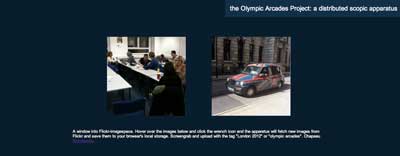
The first apparatus (with JPEG) connected JPEG, in-browser and server software and the photographer through a web installation where, when the page is accessed, software screengrabs a Flickr, Google, Bing and Yahoo image search. The JPEG protocol then encodes that screengrab as a JPEG JFIF file which is brought into the installation as a background image that the user can then screengrab and upload to their own social networks where it will be encoded as a JPEG and made searchable again. Here JPEG, software and the photographer-objects are connected within distributed “image-space” objects, “search-space” objects and ‘digital archive” objects, objects we can see as owned and certainly controlled by corporate interests such as Google, Facebook and Yahoo.
The second apparatus (outside JPEG) connected film and non-software cameras and the photographer through the creation of a stereo photographic installation. Here I took stereo Kodachrome slides of material objects around 2012. Together with the stereo viewer they create a personal, single user, scopic experience that cannot be networked, shared, embedded, copied or linked to. It is invisible, in part because of the absence of JPEG, to the Web, search engines and data-mining objects.
The third apparatus (against JPEG) connected JPEG, another imaging protocol, in-camera and in-browser software and the photographer through the creation of a digital photographic installation on a memory card together with a series of photographic prints. Using a camera that shoots RAW and JPEG-encoded files simultaneously, I created parallel collections of digital files on a memory card. Some visible to the computer, some not. Some uploadable and shareable, some not. Some interoperable, some not. I also processed some of the RAW files and produced a single print, then deleting the processed file, leaving again the digital negative, the unvisible image-file left outside distributed imaging in part because of using the ‘wrong’ protocol.
So much for the practices, actual or thought experiment. If I am not to be caricatured as a performance or conceptual artist, where’s the erm… photography.
Fanfare and unveiling… the Black Box.
For Bruno Latour, who Graham Harman holds as one of the founding fathers of object-oriented philosophy, black boxes are special types of objects that have become so everyday they pass unnoticed until we open them and see the complex sets of object relations in play within. Almost like Heidegger’s hammer, it is only when they break, become strange, are cracked open that objects become present to us.
These separate and actual objects, connect within the ‘molten core’ of the black box object. Each element or object in the work serves a particular role and has a particular relationship to each other, to JPEG and to my practice-research.
The memory card contains, if such is the right verb for the magnetic traces on a storage mechanism, an HTML page and javascript code: the first apparatus. When loaded on a computer, the viewer is presented with a distributed JPEG viewer and a tool to create their own.
On the same card are the visible JPEG JFIF and unvisible RAW files of the third apparatus. These files – not images – are the start of the Exploit, the deconstruction of JPEG’s hegemony and black box transparency. Here the supposedly neutral and apolitical protocol is rendered problematic and partial, enfolded in economics, politics and governmentality as it renders some images searchable and archivable, open to data-mining and surveillance, but also open to Exploit as that standard can be made to reconfigure our scopic regime.
The stereo slide-objects are the traces of the second apparatus, the outside protocol imaging device. They are photographic objects: decisive moments, unique photo-works of a specific photographer-object. They carry their histories as material objects in the same way they carry the gelatine in their film base or the dyes in their colours. But they exceed their relations, qualities and accidents. We can never fully encounter them. There is more to them than their presence in this box, this project or the Kodak lab. But with that said they connect with other objects, the viewing device, the viewer, the Box, the PhD project . Those relations do not define the objects. They are always more. Rather the real slide connects with the sensual viewer, a particular instantiation of a cynical viewer, a devout fan or a puzzled examiner.
Similarly the traces of the third against-protocol apparatus, the print-objects are off Net. They too are one-offs. As realisations of the processed but unsaved RAW files they too are photographic objects: decisive moments, unique photo-works of a specific photographer-object. Again, even if I spill coffee on them or colour them in with crayons, they remain photographs, that weird thing that is more than their accidents. In the box or on the wall of the White Cube they are more than their context.
Opening my black box is to find objects and object relations but never to find JPEG. Here there are the traces of my three photographic practices but JPEG, like Keyser Söze (http://www.imdb.com/title/tt0114814/), just slips out of sight/site. It has withdrawn.
Object-oriented philosophy offers a way to develop a photographic criticism that takes seriously the full range of objects enfolded and connected within contemporary imaging. Remaining rooted at the level of objects it not only draws attention to the often overlooked immaterial actants at play but also explores their connections at the level of objects in the actual presence rather than in some wider sphere of potentiality or processuality. It also offers a form of photographic practice that at the level of subject matter explores how objects speak and call us but also in terms of broader fields of imaging opens up the potential for connecting scopic objects in new ways, new configurations, new scopic experiences and new scopic struggles.