To be Frank, it’s maybe a bit presumptuous

Let’s be clear, I’m not comparing myself to Robert Frank. I was a hack photographer, a lens for hire variously photographing CEOs and CFOs for business magazines, racehorses for sports pages and some reportage for charities. Now I’m a flaneur with a fone, photographing ‘things of the day‘. No, it is not false modesty when I say that Frank and I are different photographers.

But I think we do have a common concern. At least in The Americans, Frank was interested in objects and exploring the nature of the photographer, the photo work and photography. He did this through looking to photographically explore ‘America’. In my Olympic Arcades Project I am interested in objects and looking to understand the nature of the jpeg photographer, the jpeg photo work and jpeg photography. I am doing this through photographically exploring ‘2012’.

We both set out on road trips. Frank chose to take a Ford Business Coupe and drive around America. I chose a bicycle and chose to (try and) bike around Tower Hamlets. Not as glamorous perhaps but a sort of road trip I like to think.

We both set out to photograph objects. Frank had obviously not read Graham Harman or Jane Bennett but he used his camera with a sense of vibrant matter and objects in their actuality, real but withdrawing, exceeding their relations, qualities and accidents. His jukeboxes, cigars, flags and cars form a Latour Litany of unhuman objects in a democracy of objects alongside the people whom he photographed. The scenes he framed were collections of objects.

The scenes I framed were also full of objects. But I chose to focus on fewer objects at a time – a single piece of litter, a remnant of an industrial past, an industrial artefact. What is more I chose to leave out the human object. Very different in look but sharing a common belief in the power and presence of actual, real objects. And of course when both our litanies became photographs they became another object: (part of) the photo work.

It is when as photographers Frank and I created those photo objects and created a photo-work (Frank’s paper road movie and my digital road stream), that we explored the ways in which objects connect within the heart of other objects. The Americans and The Olympic Arcades are nested objects, a space of connection between real and sensual objects and qualities that follow Harman’s FourFold.

The second parallel lies in our shared concern for our medium. We both understood that our projects were as much about photography as they were about their nominal subject. The Americans says as much about Frank the photographer, the photo work and photography as it does about America. That is why the book remains seminal. Photographers have to respond to it. They may echo or react against it but the book and the practice cannot be ignored.

I look to create a work that says something about the jpeg photographer, the jpeg image and stream and jpeg photography.

When we look at the objects created by Frank’s particular Leica practice we discover something about his position, his work and his medium, just as doubtless he discovered more about them as he worked. I have discovered things about jpeg and jpeg photography by using and abusing it. I look to my objects to say something about the jpeg photographer, jpeg photo works and jpeg photography and about what is now my research question: what is the nature, effects and connections at work in jpeg?

Frank’s photographs (and book) and my jpeg/RAW files are not texts to be read. They do not represent vibrant matter or object-oriented philosophy, they are vibrant material objects. They are traces of practice as well as theory but that does not mean that the images/files are somehow secondary. An object-oriented photography as well as an object-oriented photography/media studies accounts for images, photographer, camera, software and protocol as worthy of notice and thought because all of those objects are in play within imaging.

Frank never ‘wrote up’ his discoveries about photography, the photo work or the photographer, nor an account of his object-oriented philosophy or practice. I will, and I will do it through a consideration of the two road trips, photographic practice, and photo works in parallel… with all due deference to Frank.
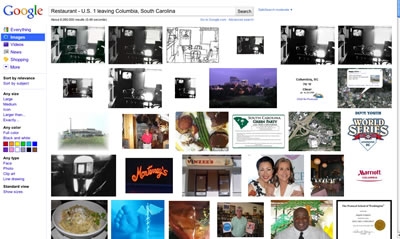
Restaurant – U.S. 1 leaving Columbia, South Carolina

Restaurant - U.S. 1 leaving Columbia, South CarolinaIn Restaurant – U.S. 1 leaving Columbia, South Carolina (image-object) a TV screen retreats. In the corner of a seemingly deserted restaurant, the unmistakable rounded corners of a 1955 TV set stands alone. There is no human presence (we will talk about Frank in a moment). The bright screen and the burnt-out window, table edge and chair seat from a classic compositional triangle and are the only light and lively presence. The three frames on the contact sheet show Frank picking the image with the only other human, the aptly-named TV evangelist, Oral Roberts. This hyperreal figure talks to no-one, preaches silently into the light.
What haunts this image (unlike the punctum-prick of the decisive moment) is the flat monotony of the collection of things in the restaurant. The arrangement by the owner (and later by Frank), the congregation of chairs,  the sacramental arrangement of napkins and condiments, the screen and its pulpit-wooden cabinet. These objects are connected but isolated; part but apart.

Restaurant – U.S. 1 leaving Columbia, South Carolina is clearly an object-picture. The objects here are flat. A mosaic of actants – TV, cathode-ray tube, light, an electron-beam representation of Roberts, chairs and salt cellar. Obviously Frank is present but the story is about those objects present to him and his camera. By necessity traditional photography is at some level a correlationist project. There is always the human. But Frank’s work draws attention to the fact that those objects have a presence and a reality beyond that human and what is more their puzzling withdrawal is not just from the human, from Frank or from us, but from each other.

From an object-oriented perspective, objects not only withdraw from the human, they withdraw from each other.  It is not just that Frank (or we) cannot connect with the totality of those object, the sides we cannot see, the subatomic, quantum dance or the accidents of its particular instantiation. The objects themselves never fully connect. The real TV screen cannot encounter the real chair in some complete presence. If they could they would melt into some single unitary, indistinct thing. Rather they connect within a new object – the TV viewing object, the absent viewer-object (the object Frank seeks to ‘capture’). The real TV screen encounter the intentional chair, a dimension of its existence. Similarly the real chair encounters an intentional TV-screen, an instantiation of its flickering. This is not ‘potentiality’ or ‘process’. To address those objects in terms of process or potential is to deny their complete actuality in any one time or space. It is not that the TV screen is only potentially in connection with the empty chair. It is fully present. It is actual and real. Vibrant materiality and must be addressed (and photographed) as such. The screen and chair cannot connect completely but they are actual and real, not potential, presences. The ‘TV viewing-object’ they connect in is actual, real and present and it is that object-oriented photography imag(in)es.

Tweets for the week :: 2011-06-05

Powered by Twitter Tools

Thinking inside the box

I have had a picture in mind as I’ve been developing this practice-research PhD. It’s been a box (black naturally, Bruno). An object. This would be what I would have created and used to learn about protocols, jpeg, objects and photography. Obviously it could not have contained jpeg – the whole point is that it withdraws. Present within software, connected with other actants it remained unvisible. I imagined three scopic apparatuses designed to explore that puzzling objects: a with protocol apparatus of mashups and screengrabs creating jpeg images of jpeg’s traces – images of the scopic stream; an outside protocol apparatus using a stereo camera to create images that could not be jpeg; an against protocol apparatus using jpeg and RAW to protocols to explore the visibility and unvisibility of encoded image data.

Each of these apparatuses had their traces – jpeg/JFIF image files, RAW files and analog slides. It was these traces that I wanted to include in the box.  Furthermore, it was using these apparatuses that enabled me to learn about protocol, objects and my own practice as an object-oriented photographer. This practice of imagining and using the apparatuses was what I need to present to the examiner.

I chose to make my conclusions part of my practice. Not just an academic account of theoretically-informed knowledge gleaned from practice but an active player, an actant in the practice-research objects I work with and will hand in to be examined on. I chose to produce a work around Robert Frank’s The Americans. I read Frank as an object-oriented photographer, his practice as built around a flat ontological photography and the The Americans photowork as an object-photowork, a conjunction of nested objects that parallels my own. I look to create written and photographic engagement with Frank as a way of engaging with what I have found about my position as a (jpeg) photographer, object-oriented (jpeg )photography and the (jpeg) photo-object. This photo/text work would be the coming together of practice and research, both a work in itself and an account of my research findings.

This needed to be in the Box.

Until now, I had been considering creating a digital object. This would bring together the protocol imagings as well as my photo/text work, research findings. I knew I did not want to place this work online as a website or installation because one of the key themes of the work was the off-Net object. I looked at the individual digital object- an eBook or digital work on an iPad, and iPhone or a Kindle. I have explored ePub open standards, PDF, KIndle AZW files, Adobe Digital Publishing folios and even Objective C or Android-authored Apps. All of these options were run through with their own issues of protocol and standards. All were their own spaces of objects within objects.

But to add those objects to the mix (although of course they are inevitably part of the protocol ecology under investigation) would be lose focus. This box is about jpeg. It’s not about IoS or e-Ink or PDF or mobility. Alongside the slides and the prints I chose to simply include the jpeg/JFIF and RAW files on a memory card. Off Net but easily on Net by connecting to a computer or device (wirelessly or by USB) that can render some files visible and other unvisible, some part of the stream and search-space others not. The images like jpeg itself were platform agnostic, but deeply connected with those platforms.

As for the text, I chose to make that, like the images and Frank’s (paper) road movie and Benjamin’s Arcades Project index cards, as individual objects – as jpeg/JFIF and RAW files. Each protocol-encoded page of the work would, like the images be visible and unvisible. In addition they could be rendered as searchable via OCR or remain mute and unvisible on the SD card.

The box cannot contain jpeg. It can contain the traces as well as the traces of where it cannot work – the slides and viewer/viewing experience.

Cafe – Beaufort, South Carolina

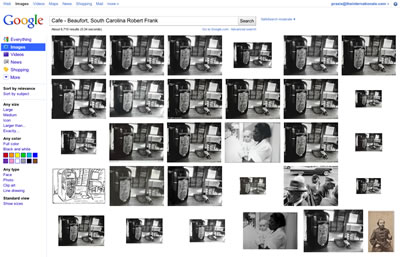
Cafe - Beaufort, South_Carolina Google SearchIn Cafe – Beaufort, South Carolina (image-object) an African-American baby crawls towards their blanket or changing mat across a wooden floor. The room has a table with a white tablecloth and two mismatched wooden chairs. Two windows are bleached out in the sun which casts panes of light across the floor. The light also falls on the glass of the giant jukebox that dominates the rule of thirds, towering over the baby but also the composition. Not places against the wall or out of the way, the jukebox takes pride of place at an angle to the bar to the left of Frank. In the contact sheet, of the five image taken, three show the bartender, larger than his jukebox which stands like a customer leaning against the counter. There is one other image of the baby crawling. In this the baby’s head is down, its legs folded not in middle of the strenuous act of crawling. In the frame Frank chose, the baby is active, a human movement in the hulking presence of the jukebox.

The frame, as with all of The Americans image-objects, cannot be looked at alone. It is a frame in his paper movie where the the preceding and succeeding images, as well as others throughout the stream are connected compositionally, thematically and in terms of objects. Here though I want to concentrate on this one nested object and Frank as the object-oriented photographer.

It is necessary to draw a distinction between the objects in the Cafe in South Carolina in 1955 and the objects as photographic representations in silver, as photographs printed in a book or pulled in as jpegs by Google’s algorithms.

Firstly the objects in the Cafe as they connected with Frank.

Frank approached these objects in the Cafe in South Carolina as actual presences. The jukebox, baby, chair, light and mat were fully present but exceeded their relations, qualities and accidents. He could not see nor photograph the quantum dance at the subatomic level within the jukebox glass, the baby’s hair or the photons of light. He could not see nor photograph the rear of the jukebox. There was more to each object than the particular manifestation before his lens. The objects withdrew but it was in that withdrawal that Frank could work. It was the fact that those objects were all equal ontologically and photographically that enabled him to take this photograph and make it work with all the others in The Americans. Most importantly each object was actual. It was not defined by its relations to any other, a plasma or a potentiality. The jukebox. The DNA in the baby. The wooden chair leg were all real, material and vibrant regardless of any other object. But there were connections. They connected with each other in the heart of other objects. The real baby object connected with the sensual floor object (a dimension of the floor object) within another object – the cafe-baby object that Frank connected with as he pressed the button and as exists now as part of Cafe – Beaufort, South Carolina. The objects are not just compositional building blocks, they are ontological ones too. And Frank’s practice depend on them so he could create image-objects.

Secondly Frank’s photographic objects.

The light photons Frank collected when he opened his Leica shutter chemically reacted with the silver objects in his film’s emulsion. That very physical and material object-connection within the negative-object was repeated as the enlarger’s photon objects were filtered through that negative to connect with the silver in the printing paper. Photography was, and I would argue remains, a very material process. The photograph Cafe – Beaufort, South Carolina whether ‘in’ the original negative or print, the printed or digital reproduction is an object. It connects with other images in his contact sheets and other images in the book or the search page. These images connect within objects -the Google search results-object, my writing-object, The Americans object. This was Frank’s project, connecting images in his paper road movie. HIs was not a project of isolated decisive moments or a relational picture essay. His was a a project of connections – objects connections within object connections within object connections.

At first glance Cafe – Beaufort, South Carolina looks like a humanist image, one that would fit into The Family of Man. It would appear to be an example of correlationist imaging – the human as the guarantor of the image and the story. The baby’s presence as the charge of the jukebox nanny, as the real in the presence of the artificial, the vibrant in the presence of the material, the motive in the presence of the static. But Frank’s method demands a flat ontology. He cannot tie jukeboxes and fenders, changing mats and dresses even babies and old men unless each can have its own vibrant material presence, unless each is actual. His practice of the stream of images demands an object-oriented approach.

To be Frank

The Robert Frank who produced his paper road movie The Americans was an object-oriented photographer. His was a flat ontology of object-actants. His documentary was of people yes, but also flags, jukeboxes, crosses, cigars, hats and cars – a Latour litany of human, non human and unhuman objects vibrant, doing things in the world. Those objects were material. They were the presences he encountered on his journey and he made re-present in his book. These real objects had histories, material conditions of production and consumption. They had pasts but also presents and presence as the jukebox watched over the crawling baby, as the cars watched over the kids making out. Most of the photographs Frank chose for The Americans included people but this was no humanist or correlationist story. Where Steichen’s The Family of Man led with people, privileging the human over a material world of object with which he struggled or for which she cared, Frank’s people are actants in a complex assemblage of objects. The working class lift operator and waitress or the society aristocrat or movie mogul are objects alongside a Santa Claus sign or a fur stole. These objects are not semiotic markers of an underlying class relation and more than the human is an archetype. They are all objects in the complex assemblage of 1950s America connected and connecting not at some external representational scale but in real world materiality of serving drinks, being ignored buy commuters or forging social and business networks. Frank is not external to this. He too is an actant. His shadow or gaze is woven into these object relations as it falls on windows or is returned suspiciously. There is no objective recorder or photo-journalistic position. There is only the position of object.

These objects are not defined by their relations. There is no exterior realm of potential, plasma or becoming in play. The objects at each indecisive moment of exposure are fully present and their reality exceeds their relations, qualities and accidents. They cannot be reduced to a mode of production or a segregationist system. This is not say that these hats and jukeboxes and fenders and crosses are isolated. Far from it. The heart of The Americans is to re-present those connections within the frame and between the frames. But those connections happen within objects not external to them.

The Americans is a nested work. The objects in the coffee-bar or on the street are connected within other objects. The sousaphone-object, the flag-object and the ‘Adlai’-badge-object connect as object within the parade-object. There is no decisive object, no punctum driving the story or the meaning. These object connect again and again with Frank within his camera-object, with me-as-object within my book object. These connection are not located in some external realm of signification or practice but within objects that are themselves actants reconnecting within other objects.

The image-objects are not somehow different to the objects in the images. They are not more or less than those objects. They are just different. The photographs (or the reproductions of the prints of the negatives…) are objects now positioned in new object-relations with the bookmark on my desk, my words on the screen, the print-out of my chapter, the code of my own images, the protocols enabling those images. These are not relations in an external realm of reading or semiotic play, they are connections within other objects – my practice-research project, an AHRC-funded PhD, an eBook, a Google search.

This object-oriented ontology is not specific to Frank. Any photographic work can be understood as object-oriented. What is particular about Frank is that his approach to documenting America, was an object-oriented practice – one starting from, located in and refusing to leave the world of objects.